- Rust 90.8%
- Python 7.6%
- Typst 0.7%
- Dockerfile 0.7%
- Mermaid 0.2%
| Filename | Latest commit message | Latest commit date |
|---|---|---|
|
|
||
| .github | ||
| distribution/docker | ||
| docs | ||
| scripts | ||
| src | ||
| .gitignore | ||
| Cargo.lock | ||
| Cargo.toml | ||
| CHANGELOG.md | ||
| example-workflow-action.png | ||
| LICENSE | ||
| openapi.json | ||
| README.md | ||
| workflow_api_sequence.mmd | ||
| workflow_api_sequence.svg | ||

paperless-llm-workflows



A privacy-first, local LLM extension for paperless-ngx that automates document processing through webhook-driven workflows — no cloud providers, no external APIs.
What It Does
paperless-llm-workflows integrates a local LLM into your paperless-ngx instance as a set of automated workflow steps. Connect it via webhooks in the paperless workflow UI and the LLM will auto-fill custom fields, suggest correspondents, generate document titles, and make conditional decisions on your documents — all processed locally on your hardware.
Why Not the Alternatives?
This project is not a chat interface for your documents and does not send anything to external APIs. If you're looking for cloud-based or chat-oriented solutions, consider:
Technical Details
- Inference engine: llama.cpp — fully local, zero external API calls
- Default model: Gemma4 E4B (Q3_0 quantized) — selected for best accuracy-to-resource ratio blog post, describing method
- Acceleration backends:
vulkan,cuda,rocm,openmp(CPU) — choose one at compile time - Runtime: model loads on first request, unloads after queue is idle to save memory
Endpoints
| Endpoint | Description |
|---|---|
POST /fill/custom_fields |
Auto-fill all empty custom fields on a document |
POST /fill/target_custom_field |
Fill a specific custom field by ID (supports custom prompts & JSON schema for longtext) |
POST /suggest/correspondent |
Use LLM reasoning to suggest the correct correspondent |
POST /suggest/title |
Generate a document title (supports Jinja-style templates) |
POST /decision |
Ask a yes/no question about the document and conditionally assign tags |
Browse the full API documentation at http://{server}:8123/api/ after starting the service, or view the static preview online.
How It Works
Each endpoint is triggered from a paperless-ngx workflow via webhook. When a webhook fires, the document is placed in a processing queue, gets a processing tag, and is sent through the LLM. After completion, results are written back to paperless and the tag is swapped to finished (or a custom next_tag).
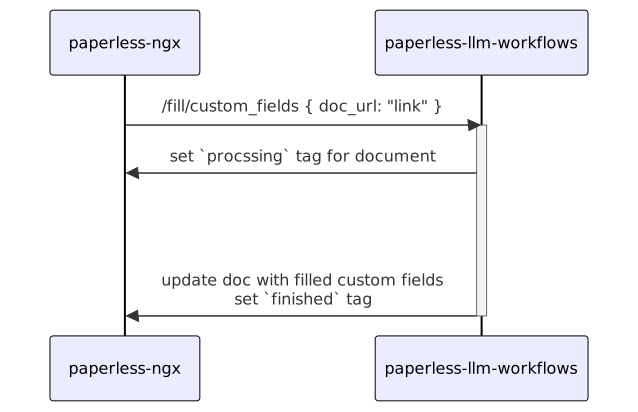
See the Workflow Guide for step-by-step setup instructions.
Quick Start
Add to your docker-compose.yml alongside paperless-ngx:
services:
  paperless-llm-workflows:
    image: ghcr.io/ju6ge/paperless-llm-workflows:latest-vulkan
    restart: unless-stopped
    ports:
      - "8123:8123"
    environment:
      - PAPERLESS_SERVER=https://your-paperless.domain
      - PAPERLESS_API_CLIENT_API_TOKEN=your-token-here
      - PAPERLESS_USER=admin
      - PAPERLESS_LLM_MAX_CTX=16384
    devices:
      - /dev/dri
    # For AMD GPUs with KFD:
    # - /dev/kfd
Then create webhook workflows in paperless-ngx pointing to http://paperless-llm-workflows:8123/{endpoint}.
For full deployment options (GPU variants, custom containers, bare metal) see the Deployment Guide.
Supported Custom Field Types
| Type | Supported | Notes |
|---|---|---|
| Boolean | ✅ | Yes/no fields extracted from document content |
| Date | ✅ | Parses dates with format guidance |
| Integer | ✅ | Numeric whole numbers |
| Number | ✅ | Decimal numbers |
| Monetary | ✅ | Currency values (2 decimal places) |
| Text | ✅ | Up to 128 characters |
| Select | ✅ | Chooses from predefined options |
| LargeText | ✅ | Long-form text; supports JSON schema for structured output |
| Document Link | ❌ | Requires cross-document resolution |
| URL | ❌ | Not yet implemented |
Configuration
Configuration is applied in layered priority (lowest to highest): TOML config file at /etc/paperless-field-extractor/config.toml, environment variables, then CLI flags.
| Option | Env Variable | Default | Description |
|---|---|---|---|
host |
PAPERLESS_WEBHOOK_HOST |
0.0.0.0 |
Listen address |
port |
PAPERLESS_WEBHOOK_PORT |
8123 |
Listen port |
paperless_server |
PAPERLESS_SERVER |
— | Your paperless-ngx URL (required) |
webhook_public_base_url |
WEBHOOK_PULIC_HOST |
— | Public URL for auto-setup of workflows |
model |
GGUF_MODEL_PATH |
— | Path to GGUF model file (required) |
num_gpu_layers |
NUM_GPU_LAYERS |
1024 |
GPU layers for offloading (0 = all) |
max_ctx |
PAPERLESS_LLM_MAX_CTX |
0 |
Max context tokens (0 = model default) |
processing_tag |
PROCESSING_TAG_NAME |
🧠 processing |
Tag applied during processing |
processing_color |
PROCESSING_TAG_COLOR |
#ffe000 |
Processing tag color |
finished_tag |
FINISHED_TAG_NAME |
🏷️ finished |
Tag applied after successful processing |
finished_color |
FINSHED_TAG_COLOR |
#40aebf |
Finished tag color |
error_tag_enable |
ERROR_TAG_ENABLE |
false |
Enable error tagging (opt-in) |
error_tag |
ERROR_TAG_NAME |
⚠️ error |
Error tag name |
error_color |
ERROR_TAG_COLOR |
#e45858 |
Error tag color |
tag_user_name |
PAPERLESS_USER |
user |
Paperless username for tag creation |
The PAPERLESS_API_CLIENT_API_TOKEN environment variable (not a config option) is also required — it authenticates with the paperless-ngx API.
For detailed configuration examples and advanced setups, see the Configuration Reference.
Additional Resources
- API Overview — Async processing model, request contract, error handling — plus auto-generated OpenAPI docs
- Benchmarking — Evaluate and compare LLM models against your documents
- Building from Source — Compile with custom backends and features
- Configuration Reference — Full option reference with defaults
- Deployment Guide — Docker, compose, bare metal, GPU setup
- FAQ & Troubleshooting — Common issues and solutions
- Workflow Guide — Step-by-step webhook setup in paperless-ngx
License
AGPL-3.0